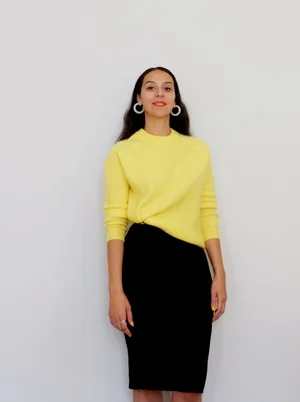
Six-year-old
Thirty years ago, as a six-year-old, I was sitting in my classroom at elementary school when I was asked to draw a park of the future. Cyprus, where I was born and raised, was negotiating its entry into the European Union, and the country’s vision was bursting with growth. I came to realise that, on that day, I drew my first project: a park in the future.
Time moves forward, and I have followed a path of exploring, learning, trying, failing and succeeding. Now I look at this same drawing as both a biased viewer and, conceivably, a professional. It has taken layers of understanding to decode it, and as I begin this blog of thoughts on architecture, it feels like a good place to start.
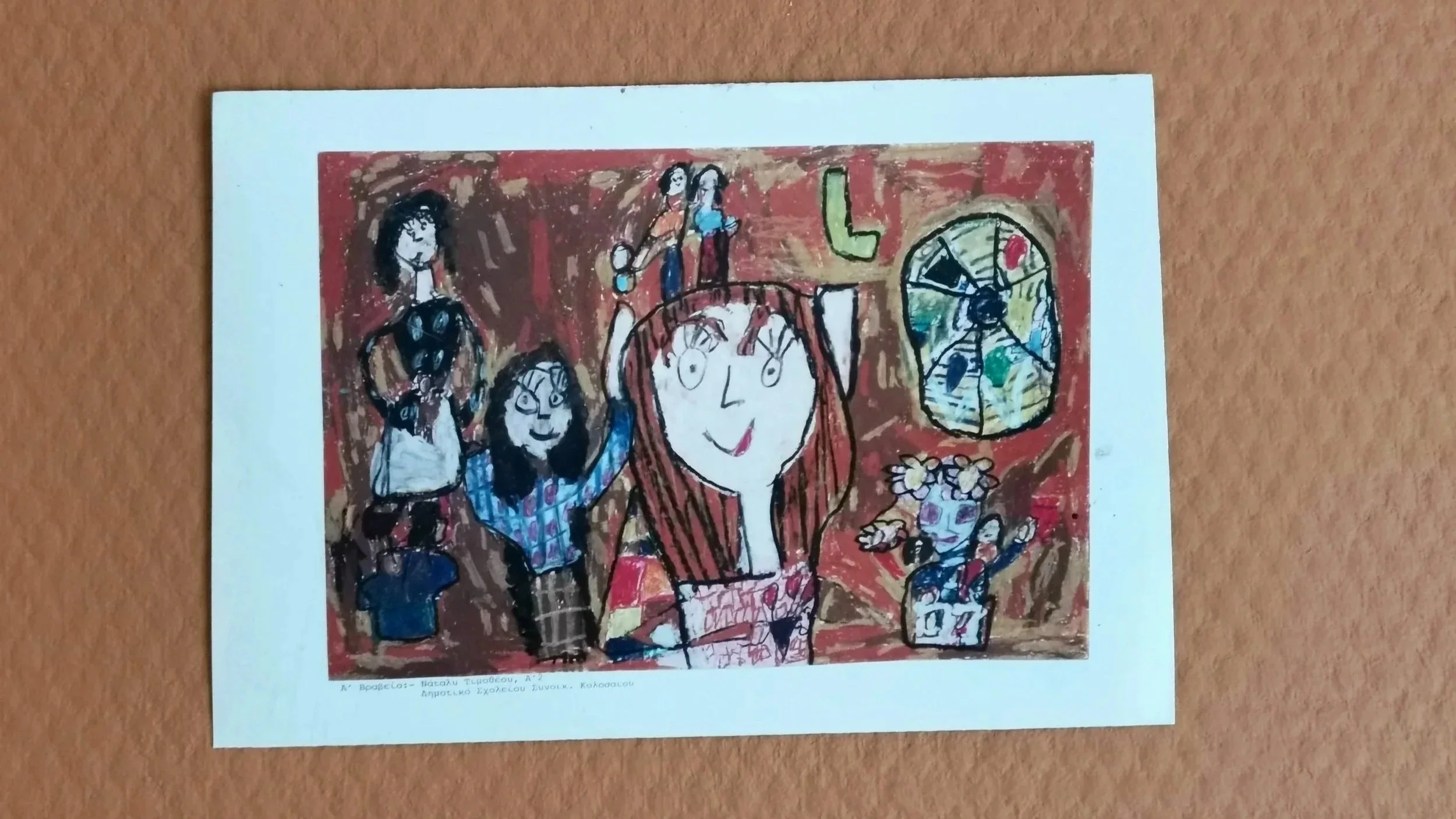
At the centre of the park is myself, clearly, as it is my world that I put together using crayons full of paraffin. Around me are my friends, Annita and Christodoula. In the background, a couple holding their child, and on the other side, there is one more child whom I do not seem to remember. Life is, and has always been, of the highest importance to me.
Then there is a series of toys, because no child imagines a park without a playground. These toys embodied the element of “the future” as I understood it at the time. In the corner is a robot with flowers that acts as a carousel. Right above it is a spinning wheel with different shapes, which gives you a T-shirt if you win the corresponding shape and colour. Random, I know, but perhaps it was a wish for togetherness—a team.
In the top corner is my favourite toy: the green sock. This sock is an observatory from which one could see the moon.
The moon, the robots, the colours and the shapes were the future in my eyes. A couple of flowers, too. It is a narrative that we somehow still entertain in the Western world as “the future.” Dare I add: flying cars, self-driving cars, inhabiting Mars, artificial intelligence.
Now, as an architect, I notice something much more interesting in the drawing.
No grass.
No trees.
A bold surface of plain earth—and, to my credit, an attempt at shading and creating a diversity of ground.
The future, and the present, clearly need what was already missing back then: a park. Third spaces. Freedom. Connection to one another. Cohabitation. Harmony with nature.
During the summer of 2026, Europe experienced some of its highest temperatures on record. Wildfires spread, air conditioners sold out, and the brown earth I once drew as part of the Mediterranean climate I call home became a reality in London’s Hyde Park. That image, appearing in the news, was also what unfolded some of the thoughts I describe here.
They say that “a society grows great when old people plant trees whose shade they know they shall never sit in.”
I would ask a comparable question:
Is architecture the set of pillars we design for a society we will never experience?
I think about this every time I take my nieces and nephews to the playground next to my parents house which is the archetype for most playgrounds/ parks in my town, Limassol in Cyprus.
Still no grass.
Still no trees.
Toys made in metal burning under the hot sun, benches vandalised, plenty of colourful trash, occasionally an overfilled bin with flies around and some wobbling protective flooring that the sun once more has worn them down. We will never have green grass fields that Hyde Park is known for, but we do have what our land is giving us. Our soil, our sun and our sea.
Decolonising the archetypes that prevent access to the core of our evolving identities and evolving needs is the future park I would draw today.