1936 Neufert
An archetype is not born out of thin air; it is a result. This is also great news, because different actions will lead to different results.
I do not identify the mere existence of archetypes as a core issue. Quite the opposite: it is their unification, and therefore their monopolisation, that is problematic. Industrialism, standardisation, rapid growth, capitalism, mass production: in a few words, the gradual and lasting erasure of diversity.
In the West, standardisation provided a foundation for restoration and relief, primarily in the aftermath of the World Wars. Following the Industrial Revolution, developments in machinery enabled production to respond rapidly to the needs of the masses. To produce. Employment was growing, housing was being built, sanitary conditions were improving, and quality of life was increasing for a broader segment of society, alongside many other benefits that, for now, I will leave as a vague reference.
My reasoning for this is the need we face at this moment in history to move beyond nostalgia for the economic and social boom that we, as people from what are identified as “developed countries”, have witnessed over the past decades, and to broaden our understanding of its consequences and side effects. As I attempt to map space and time in this short personal reflection, I want to offer a little more perspective on what unification and monopoly mean from my point of view.
The last countries in Europe to recognise equal voting rights for all citizens, regardless of gender, were Switzerland, in 1971, and Liechtenstein, in 1984, while Finland was the first, introducing women's suffrage in 1906. My grandfather was born in 1909, and I was born in 1990. I am leaving this here as a side note.
How do equal voting rights relate to archetypes?
As an architect, I have often based my decision-making processes on Neufert: Architects' Data, as it is a reference book that can answer many questions about construction, though not all of them. It would be overwhelming and unproductive not to have and share common ground, but it is unwise to limit ourselves to its own limits.
The manual was first published in 1936, and since then it has gone through 11 editions and been translated into 18 languages. Its author, Ernst Neufert, was born in 1900 and died in 1986. His lifetime almost spans the period between the first and last European countries to grant women voting rights. Context matters. The societal foundations on which we build matter.
A few summers ago, I was drawing up a proposal for the development of family houses and had a question regarding the dimensions required for a cul-de-sac. While looking through the pages, my eyes caught a drawing on pg.255 of the Greek edition. There was one single woman depicted on the entire page dedicated to bathrooms, and yes, as you can clearly see, she is the cleaning lady.
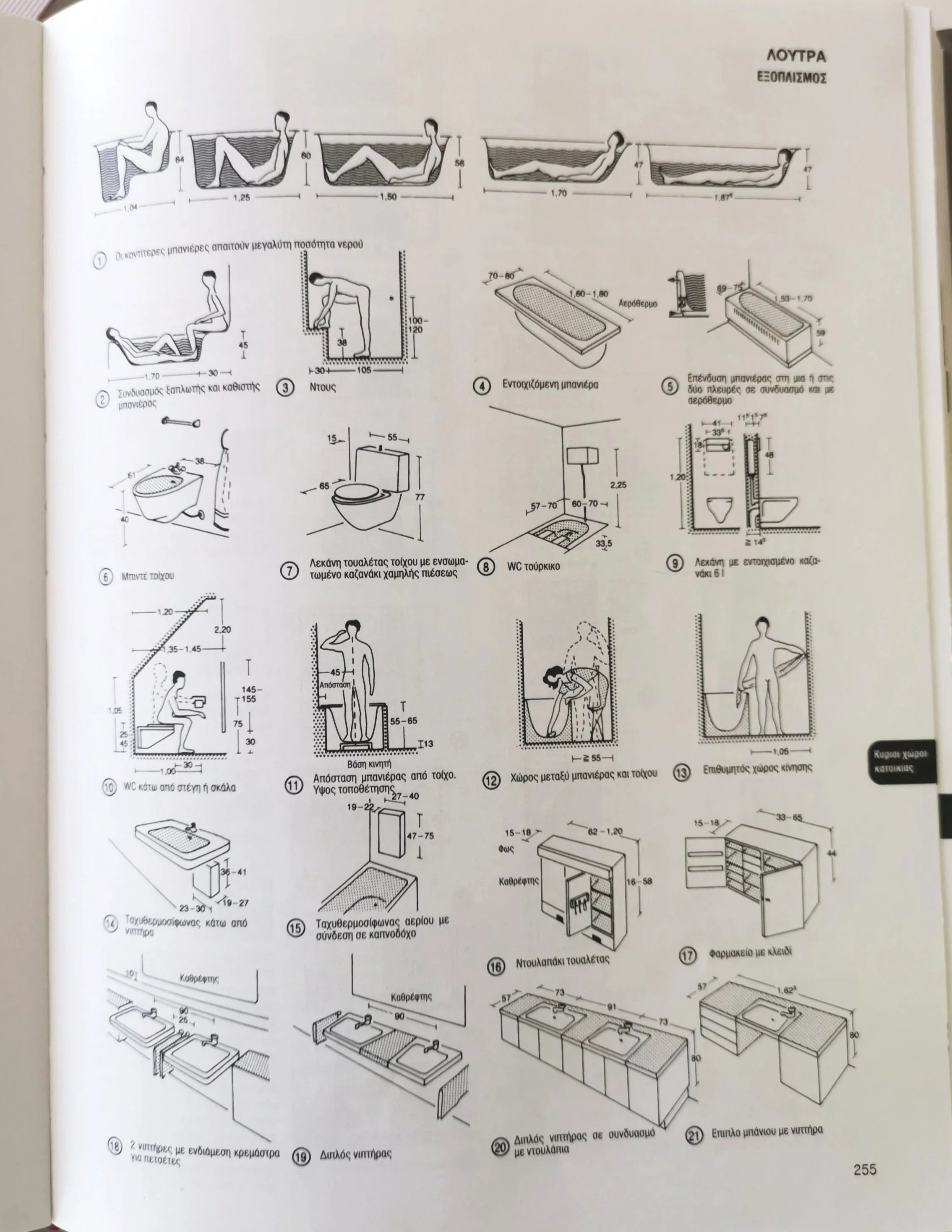
I am aware that this observation might often be dismissed by fellow architects and colleagues with a response along the lines of: “Yes, that was a different time. We know that women don't enter bathrooms only to clean them, Nataly.” But please bear with me for a minute.
Failing to evolve and expand the data we hold and use is a risk, and those shortcomings are translated directly into architecture as a product. Architects and the construction industry do not offer an off-the-shelf product, nor one with a short lifespan. More importantly, they produce something with multiple and significant impacts.
Accepting facts from the past without critically examining their context is a high price we are paying today, and one that future generations will also pay if those facts remain unchallenged.
Alongside this limited understanding of social context and of women as equal members of society, there are many other social groups and multispecies whose needs and perspectives remain underrepresented. This is the culture of monopoly: a centralised perspective. And I admit, it is far more capital-efficient to narrow all identities down to a one-size-fits-all approach.
But the illusion that one size should fit all is failing. That is a direct translation of a monopolistic perspective. The answer is choice. The answer is belonging. The answer is, and always has been, inclusion.
Decentralising our design and building processes means opening ourselves up to enriching realities and identities. Uniformly air-conditioned, often glazed, box-shaped buildings appearing across vastly different climates, cultures, and societies have saturated the field. Globalisation plays a huge role in this, as do the monopolisation of technologies and the establishment of certificates and norms that mask ongoing issues. Yet it has been clear for some time that this is a direction of linear thinking leading towards a dead end.
In fact, no one has ever played the board game Monopoly and walked away feeling fulfilled, connected, and hopeful.
This is not a call for anarchy. It is an invitation to critical thinking that can lead to inclusivity and equality—for our societies and our living, breathing planet.